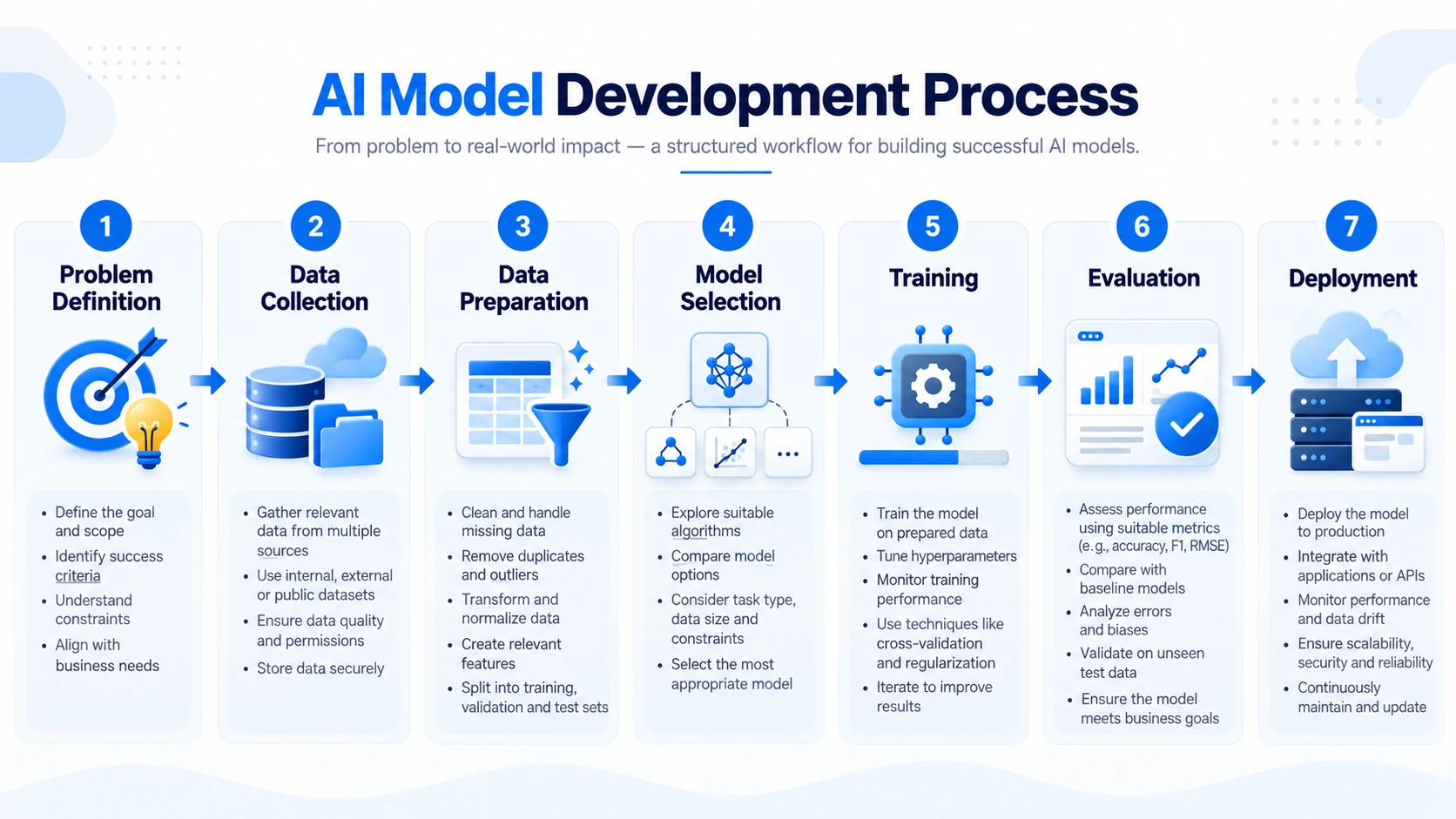
Building an AI model involves defining a problem, collecting data, selecting an algorithm, training the system, and testing its accuracy. You can create simple models using Python and machine learning libraries without expensive equipment. Understanding how to build an AI model helps beginners develop applications that recognize patterns, predict outcomes, and automate tasks.
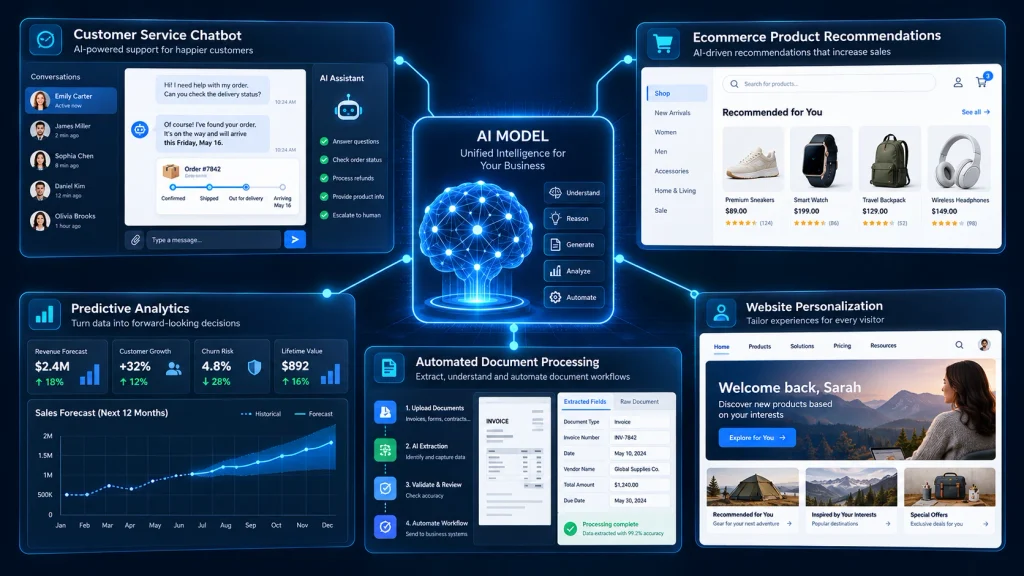
Artificial intelligence supports everything from customer service chatbots to product recommendations and business analytics. Although advanced AI systems require considerable resources, small machine learning projects offer an accessible starting point. This guide explains the development process and the tools needed to create your first model.
AI Models And How They Work
An artificial intelligence model is a computer system that processes information and produces predictions, classifications, or other outputs. Machine learning models identify patterns in training data instead of relying entirely on manually programmed rules. For example, an online store might use machine learning to recommend products based on customer behavior. Similarly, a financial application could analyze historical transactions to identify unusual activity.
Most machine learning projects involve three main activities: training, evaluation, and prediction. During training, the model identifies relationships between different variables. Evaluation measures its performance using examples it has not learned from directly. Finally, the trained model processes new information and generates results. The quality of those results depends heavily on the training data, chosen algorithm, and evaluation process.
Different Types Of AI Models
AI models use different learning techniques depending on the problem they need to solve. Supervised learning works with labeled examples, while unsupervised learning identifies patterns without predefined answers. Reinforcement learning develops decision-making strategies through rewards and feedback. Deep learning uses multilayer neural networks to handle complex information, including images, speech, and language.
The following table compares these approaches and their practical applications.
| AI Model Type | How It Works | Common Application |
|---|---|---|
| Supervised Learning | Learns from labeled examples | Spam detection |
| Unsupervised Learning | Identifies hidden patterns | Customer segmentation |
| Reinforcement Learning | Learns through rewards | Robotics and game AI |
| Deep Learning | Uses multilayer neural networks | Image and speech recognition |
Beginners should usually start with supervised learning because it offers understandable training examples and measurable results. You can experiment with classification or numerical prediction before exploring complex neural networks.

Choosing The Right Problem For Your AI Model
Before writing code, identify a specific problem that artificial intelligence could solve. A clearly defined objective makes it easier to select data, measure performance, and determine whether the model works. For example, a customer support company might want to categorize incoming inquiries automatically. A retailer could develop a model that predicts product demand using historical sales information.
Start with a manageable project rather than attempting to recreate a sophisticated conversational AI system. Suitable beginner projects include classifying flower species, detecting spam messages, or estimating house prices. Define your expected input and output before development. Also, consider whether ordinary programming could solve the task more simply. Machine learning becomes especially useful when complicated patterns make fixed programming rules impractical.
Collecting And Preparing Training Data
Data quality has a major influence on model performance. Before you begin training, collect examples that accurately represent your problem. Sources may include spreadsheets, company records, public datasets, or authorized application interfaces. For a sales prediction model, useful information might include product prices, historical purchases, and seasonal demand. Always obtain proper permission before using private information.
Next, clean the dataset by removing duplicates, correcting inaccurate values, and handling missing information. Divide your examples into training, validation, and testing datasets. Training data teaches the model, validation data supports improvements, and testing data measures final performance. A 70/15/15 split provides one possible starting point, although the ideal proportions vary. Keep testing information separate to prevent misleading results. Additionally, check whether your dataset fairly represents the situations your model will encounter.
Selecting Tools And Frameworks For AI Development
Choosing the right tools makes AI development more manageable. Python is a popular starting point because its syntax is relatively accessible and its libraries support common machine learning tasks. Pandas helps organize datasets, while NumPy supports numerical operations. Scikit-learn provides algorithms for classification, regression, and clustering. Developers often use TensorFlow or PyTorch for more advanced neural network projects.
Google Colab also provides a browser-based environment for running Python code without a complicated local setup. For beginners, Python and Scikit-learn are generally sufficient. The official Scikit-learn documentation explains model training, prediction, and evaluation. Choose software according to your project rather than its popularity. Simple classification problems rarely need expensive computing infrastructure or sophisticated deep learning frameworks.
Training Your First AI Model
Training helps an algorithm identify relationships between input information and expected results. To practice how to build an AI model, you can use the Iris flower dataset included with Scikit-learn. This dataset contains flower measurements and species labels. A classification algorithm can examine those measurements and predict which species a new flower belongs to.
The following Python example creates a basic classification model.
from sklearn.datasets import load_iris
from sklearn.model_selection import train_test_split
from sklearn.ensemble import RandomForestClassifier
from sklearn.metrics import accuracy_score

iris = load_iris()
X_train, X_test, y_train, y_test = train_test_split(
    iris.data, iris.target,
    test_size=0.2,
    random_state=42,
    stratify=iris.target
)

model = RandomForestClassifier(random_state=42)
model.fit(X_train, y_train)

predictions = model.predict(X_test)
print("Accuracy:", accuracy_score(y_test, predictions))
First, the program loads the dataset and separates it into training and testing groups. Next, the random forest algorithm learns relationships between flower measurements and their species. Finally, the model predicts species for test examples and calculates accuracy. You can run this code after installing Scikit-learn using pip install scikit-learn. This small project demonstrates the main training workflow without requiring advanced mathematical knowledge.

Testing And Improving Model Performance
Testing determines whether your model can handle information beyond its training examples. Accuracy measures the proportion of correct predictions, but other metrics may reveal additional problems. Precision measures how often positive predictions are correct, while recall measures how many actual positive examples the model identifies. For numerical predictions, developers often measure the difference between predicted and actual values.
Two common problems are overfitting and underfitting. Overfitting occurs when a model learns training-specific details but struggles with new information. Underfitting occurs when an algorithm fails to capture important patterns. You can improve performance by collecting better examples, adjusting model parameters, or selecting another algorithm. Cross-validation can also help assess reliability. However, avoid repeatedly adjusting the model based on final test results because this weakens the evaluation.
Deploying An AI Model For Real-World Use
Deployment makes your trained model available to websites, applications, or business systems. Developers commonly use APIs to connect machine learning models with other software. For example, an ecommerce website could send customer preferences to a recommendation model and display suggested products. Similarly, a support platform could classify customer messages before directing them to the correct department.
Python frameworks such as FastAPI and Flask can help create these integrations. Businesses can also use professional web development services to connect AI-powered functionality with existing websites and applications. After deployment, monitor prediction quality, response times, and security. Update the model when changing data patterns reduce its effectiveness. Businesses interested in ready-to-use automation can also explore AI services instead of training every model independently.

Conclusion
Learning how to build an AI model starts with selecting a practical problem and preparing suitable training data. Python and machine learning libraries make it possible to create basic models without advanced infrastructure. Careful testing helps identify weaknesses before deployment.
Start with a small supervised learning project, evaluate its results, and gradually explore more advanced techniques. As your experience grows, you can apply machine learning to customer support, ecommerce, analytics, and automation. At Best Website Builder Group, businesses can find professional website development and AI integration solutions that connect intelligent technology with everyday operations.