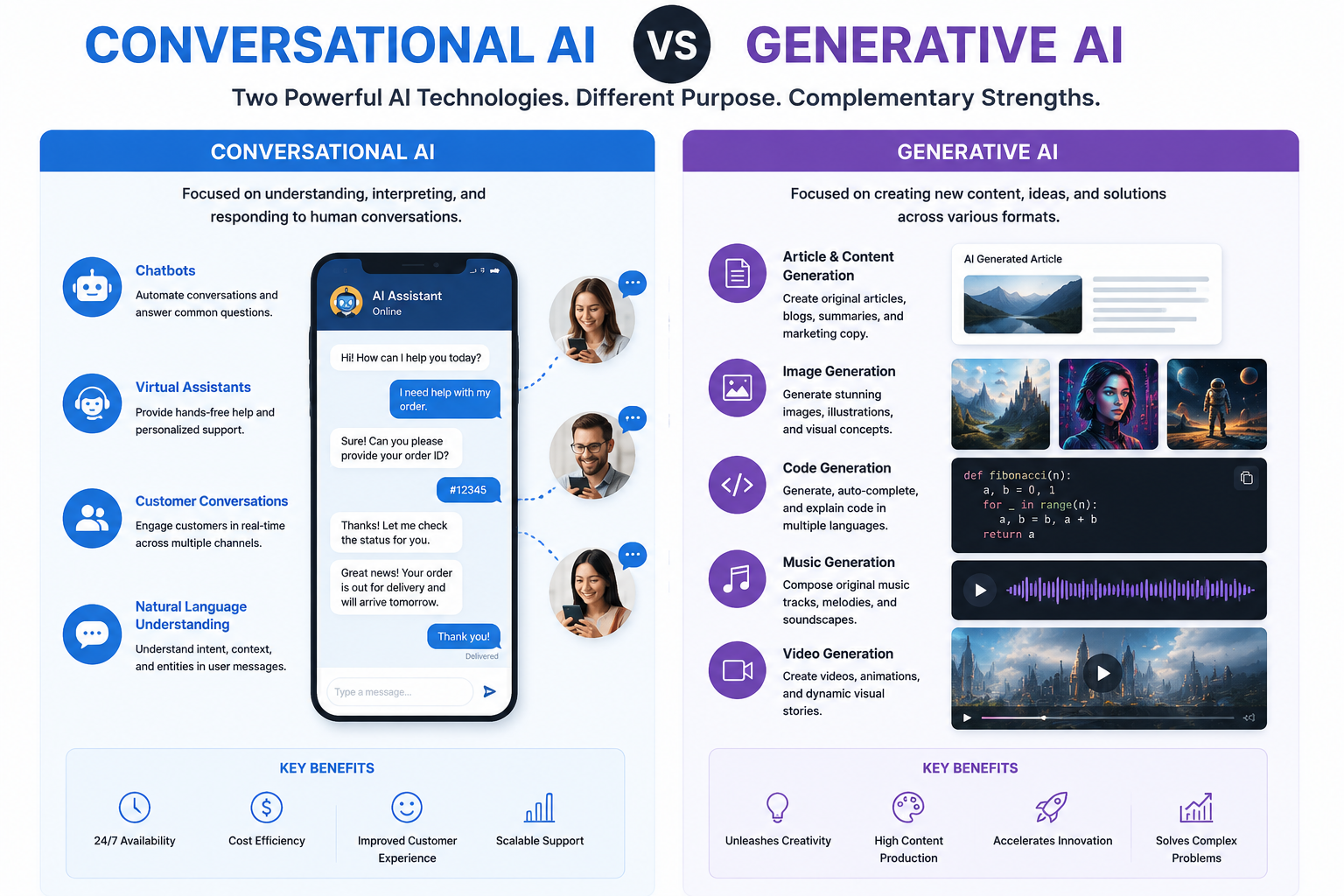
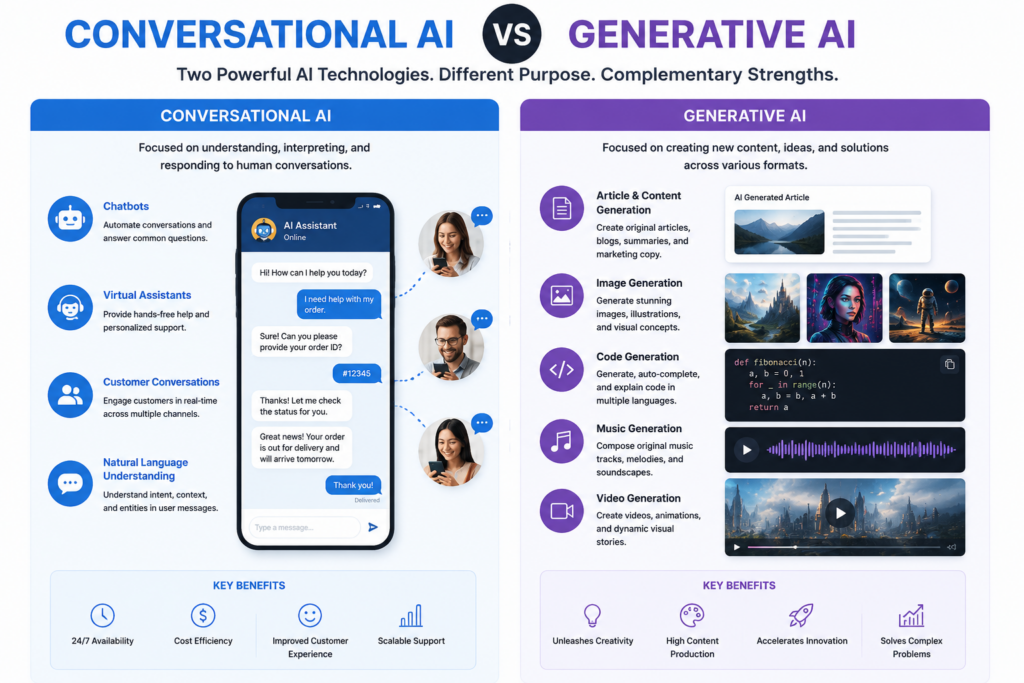
Artificial intelligence now supports customer service, content creation, research, sales, coding, and many other business tasks. What is the difference between conversational AI and generative AI? Conversational AI focuses on creating natural interactions between people and machines, while generative AI creates new content such as text, images, audio, video, or code. The two technologies often work together, which is why they can seem identical. Conversational systems manage dialogue, context, and user intent. Generative systems produce original outputs based on prompts and training data.
The distinction also affects how companies plan AI projects. A business that wants to answer customer questions needs a system that can manage conversation flow and retrieve accurate information. A marketing team that needs articles, images, or campaign ideas may place more value on generative capabilities. Some platforms combine both functions, but the project goal should still guide the technology choice. Clear goals prevent businesses from buying impressive tools that fail to solve the actual problem.
What Conversational AI Is Designed To Do
Conversational AI allows software to communicate with people through natural language. It powers chatbots, voice assistants, support agents, booking tools, and automated phone systems. These systems interpret what a user says, identify the intent behind the message, and choose an appropriate response. They also track context so the conversation can continue without forcing the user to repeat every detail. For example, a customer might ask whether an item is available and then ask when it can arrive. A capable system connects the second question to the first product instead of treating it as a separate request.
This technology often combines natural language processing, intent recognition, speech recognition, and dialogue management. Businesses use it to answer routine questions, qualify leads, schedule appointments, and route support requests. The goal is not always to create something new. In many cases, the system needs to find the correct information and present it clearly. Companies that connect these tools with a well-planned website can create smoother customer journeys. Professional Website Redesign can help organize content, forms, and conversion paths so an AI assistant supports the site instead of confusing visitors.
What Generative AI Creates From Prompts And Data
Generative AI produces new material based on instructions from a user. It can draft emails, write code, create images, summarize documents, develop marketing concepts, compose music, or generate synthetic voices. These models learn patterns from large collections of data and use those patterns to produce outputs that match the request. A user might ask for a product description, a software function, or an image concept. The system then creates a response instead of selecting one fixed answer from a scripted library.
When comparing what is the difference between conversational AI and generative AI, content creation provides the clearest dividing line. Generative technology specializes in producing material, while conversational technology specializes in managing an exchange. However, generated output still needs human review. A polished response can contain errors, weak claims, or information that does not match the brand. Businesses should check accuracy, originality, tone, and legal concerns before publishing AI-assisted content. The technology speeds up drafting and idea development, but experienced people still guide strategy and approve the final work.
Why The Two Technologies Often Appear In The Same Tool
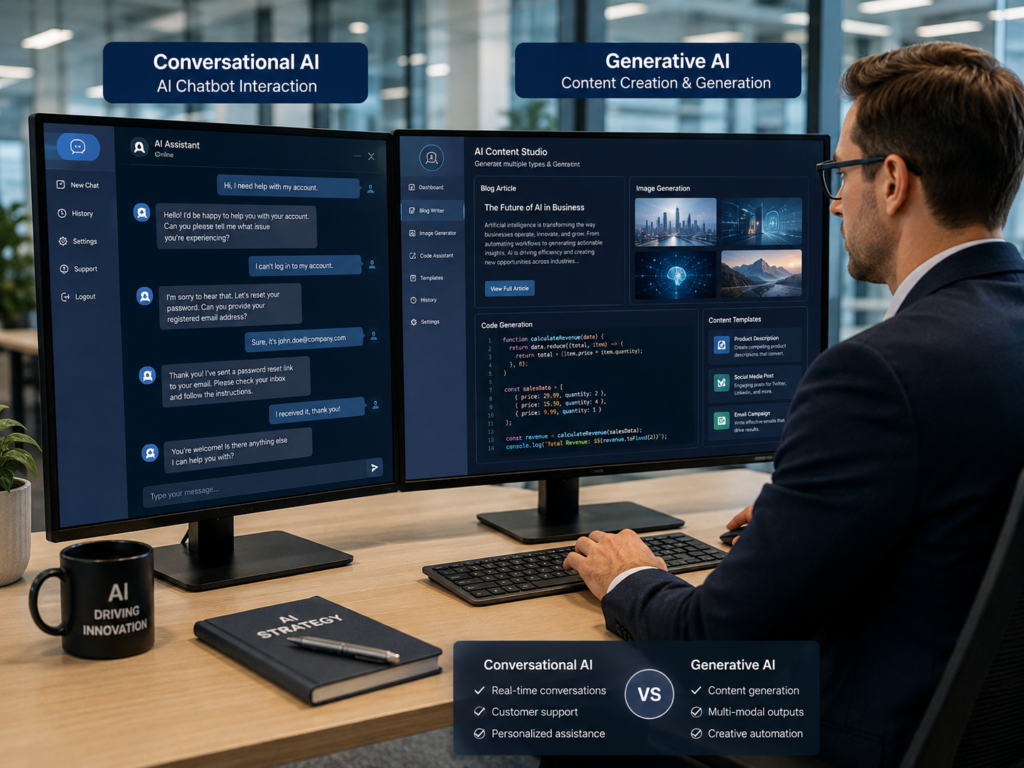
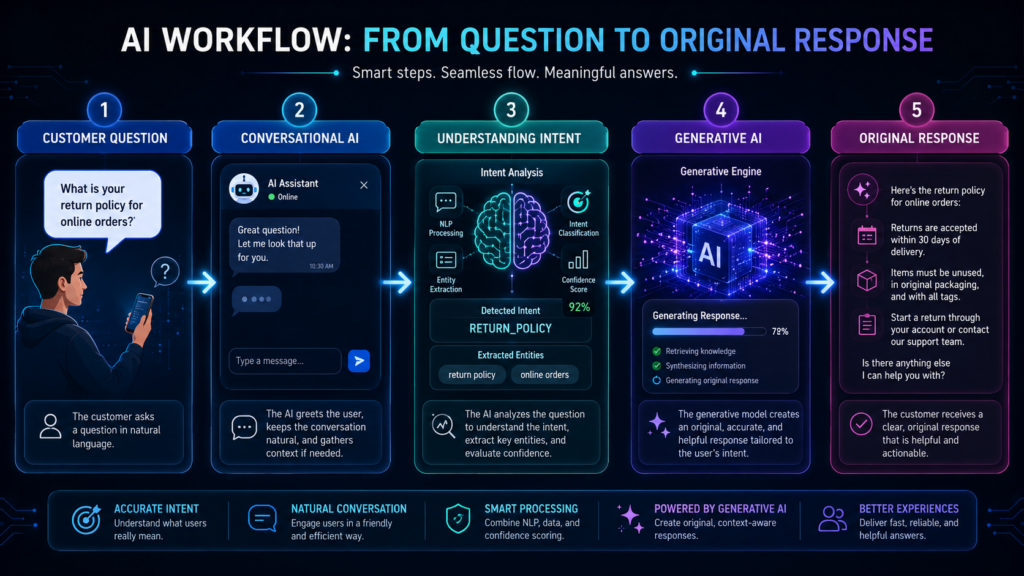
Modern AI platforms often combine conversation management with content generation. This combination allows users to ask questions naturally and receive detailed, original responses. The conversational layer tracks the dialogue, remembers recent context, and identifies what the user wants. The generative layer creates the answer, recommendation, summary, or draft. A sales assistant might ask a prospect about business needs, interpret the responses, and generate a personalized follow-up message. A support assistant might collect account details, search approved information, and explain the next steps in plain language.
This overlap can make the categories difficult to separate. The interface may look like a simple chat window, yet several AI systems may operate behind it. One component processes language, another retrieves company data, and another generates the response. The best way to distinguish them is to look at the primary function. If the system mainly manages interaction, it leans toward conversational technology. If it mainly creates new material, it leans toward generative technology. Many useful business tools need both, but each component still solves a different part of the problem.
Business Applications For Conversational AI
Businesses often introduce conversational AI to improve customer experiences while reducing the workload on support and sales teams. AI-powered chatbots can answer frequently asked questions, recommend products, schedule appointments, qualify leads, and provide updates on orders or service requests. Instead of waiting for business hours, customers receive immediate responses at any time of the day. This improves satisfaction while allowing employees to concentrate on situations that require human judgment and personal attention.
Conversational AI also supports internal operations. Employees can use virtual assistants to search company documents, retrieve procedures, or access policy information without manually browsing multiple systems. Sales teams can receive instant answers about products, pricing, or customer records during conversations. The technology works best when it connects to reliable business data and follows clearly defined workflows. Businesses that plan these interactions carefully create faster, more consistent experiences that benefit both customers and employees.

Business Applications For Generative AI
Generative AI supports a much broader range of creative and analytical tasks. Marketing teams use it to draft blog posts, social media captions, email campaigns, and advertising copy. Designers use it to develop concept images and creative ideas. Software developers generate code snippets, documentation, and debugging suggestions. Business owners can summarize reports, create presentations, and brainstorm product ideas within minutes instead of hours.
Although these capabilities save considerable time, businesses should treat AI-generated content as a starting point rather than a finished product. Every output should be reviewed for factual accuracy, brand consistency, legal compliance, and originality. Human expertise remains essential because successful communication depends on context, experience, and strategic thinking. Artificial intelligence accelerates production, but people still determine the quality and business value of the final result.
Choosing The Right AI For Your Business Goals
The best technology depends entirely on the problem a business wants to solve. Organizations that receive large numbers of customer inquiries often benefit most from conversational AI because it improves response times and customer service. Businesses focused on producing content, developing software, creating marketing campaigns, or accelerating research may gain greater value from generative AI. Many organizations eventually combine both approaches because customer interactions and content creation frequently support the same business objectives.
Rather than selecting technology because it is popular, companies should begin by identifying operational challenges. They should define clear goals, evaluate existing workflows, and determine where automation or content generation can provide measurable improvements. Businesses that combine AI with professional Content SEO Services often create stronger digital strategies by producing valuable content while maintaining quality, consistency, and search visibility.
How AI Continues To Change Business Operations
Artificial intelligence continues evolving as models become more capable and businesses discover new applications. Conversational AI is becoming better at managing longer discussions, recognizing customer intent, and supporting more natural interactions. Generative AI continues improving its ability to create high-quality text, code, images, and other forms of digital content. These advances allow businesses to automate more complex workflows while improving productivity across departments.
Organizations should also establish clear governance for AI adoption. Employees need guidance on when AI should assist with work and when human review is required. According to the National Institute of Standards and Technology (NIST), responsible AI implementation should emphasize reliability, transparency, and effective risk management. Businesses that balance innovation with responsible oversight often achieve stronger long-term results while maintaining customer trust.
Conclusion
What is the difference between conversational AI and generative AI? Conversational AI focuses on managing natural conversations between people and machines, while generative AI creates original content such as text, images, code, audio, and other digital assets. Although many modern platforms combine both technologies, each serves a different purpose and solves different business challenges.
Companies that understand these differences can choose solutions that align with their goals instead of investing in unnecessary features. Whether the priority is improving customer service, creating marketing content, streamlining internal operations, or accelerating software development, selecting the right AI approach leads to better outcomes. Businesses looking to integrate modern AI solutions with effective digital strategies often work with Best Website Builder Group to build scalable systems that support long-term growth and innovation.