
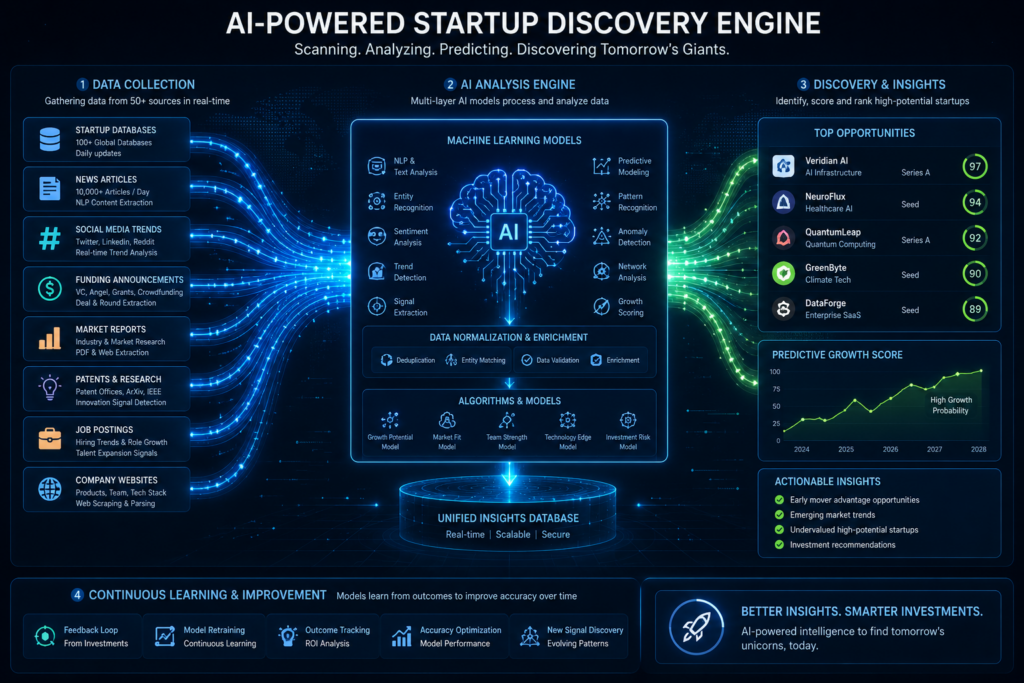
Finding promising startups used to require hours of research, networking events, industry reports, and manual outreach. Today, artificial intelligence can analyze enormous amounts of business data in seconds, making startup discovery faster and more accurate than ever before. If you are asking what AI-driven platforms can automate startup discovery, the answer includes a growing category of tools that use machine learning, predictive analytics, and data aggregation to identify emerging companies with strong growth potential. These platforms help investors, agencies, recruiters, and business development teams uncover opportunities that might otherwise go unnoticed. Instead of sorting through thousands of companies manually, users can rely on AI to surface startups that match specific criteria, industries, funding stages, or growth patterns. The result is a more efficient and scalable approach to identifying high-potential businesses.

Why Startup Discovery Has Become More Complex
The startup ecosystem continues to expand rapidly. New companies launch every day across industries such as artificial intelligence, e-commerce, healthcare, fintech, cybersecurity, and software development. While this growth creates opportunities, it also creates challenges. Identifying which startups deserve attention becomes increasingly difficult when thousands of businesses compete for visibility.
Traditional research methods often struggle to keep pace with the volume of available information. Funding announcements, hiring activity, product launches, website traffic trends, leadership changes, and social media engagement all provide valuable signals, but manually tracking these indicators is time-consuming. AI-powered platforms solve this problem by monitoring multiple data sources simultaneously and highlighting companies that show meaningful growth patterns. This ability to process massive amounts of information quickly has transformed startup discovery from a largely manual process into a data-driven strategy.
Crunchbase And Its AI-Powered Discovery Features
Crunchbase remains one of the most recognized platforms for startup discovery. While many people know it for company profiles and funding data, the platform also incorporates advanced analytics to help users identify growing businesses. AI-powered filtering allows users to search by funding stage, industry, location, revenue estimates, employee growth, and investment activity.
Investors often use Crunchbase to monitor recently funded startups because funding events frequently indicate expansion plans and increased spending. Agencies also use the platform to identify companies that may require marketing, development, or consulting services. Rather than searching company by company, users can create targeted lists that automatically surface businesses meeting specific criteria. The platform’s combination of data depth and filtering capabilities makes it one of the most widely used tools for startup research.

How CB Insights Uses Predictive Intelligence
CB Insights approaches startup discovery through predictive analytics. Instead of focusing solely on historical data, the platform attempts to forecast future company performance using machine learning models. One of its best-known features is the Mosaic Score, which evaluates startups based on funding activity, market traction, partnerships, hiring patterns, and other growth signals.
This predictive approach helps users identify companies that may become market leaders before they achieve widespread recognition. Investors often use these insights to discover opportunities earlier in the company lifecycle. Businesses involved in strategic partnerships and acquisitions also rely on predictive intelligence to identify emerging players within their industries. The ability to combine historical performance with future growth indicators makes CB Insights a valuable resource for organizations seeking a competitive advantage.
PitchBook For Deep Startup Intelligence
PitchBook provides extensive data on private companies, venture capital activity, mergers, acquisitions, and investment trends. Its AI-driven search capabilities help users identify startups based on highly specific criteria. Investors frequently use PitchBook to evaluate market opportunities, while business development teams use it to identify companies entering growth phases.
One advantage of PitchBook is the depth of information available for each company. Users can review funding rounds, investor relationships, executive leadership, financial estimates, and market positioning. AI-enhanced filtering allows large datasets to be narrowed quickly, helping users focus on the most relevant opportunities. Organizations that require detailed startup intelligence often view PitchBook as a comprehensive research solution.
Harmonic And The Rise Of AI-Native Startup Discovery
Unlike traditional business databases, Harmonic was designed specifically for modern startup discovery. The platform continuously scans the internet, company websites, hiring platforms, social networks, and public records to identify new startups and growth signals. This approach allows Harmonic to discover companies that may not yet appear in conventional databases.
The platform is particularly popular among venture capital firms and recruiters because it focuses heavily on emerging companies. Machine learning models evaluate factors such as hiring growth, founder activity, product launches, and online presence to identify startups showing momentum. As AI technology continues to improve, platforms like Harmonic demonstrate how automated discovery can uncover opportunities much earlier than traditional research methods.

Using Clay To Build Automated Startup Research Workflows
Clay has become increasingly popular among agencies, sales teams, and growth professionals because it combines startup discovery with automated data enrichment. Rather than functioning as a standalone database, Clay connects with multiple data sources and uses AI to enhance company profiles automatically.
Users can build workflows that identify startups meeting specific conditions and then enrich those records with contact information, hiring data, technology stacks, funding activity, and other valuable insights. This reduces the amount of manual research required before outreach begins.
Businesses looking to scale lead generation often integrate discovery platforms with customer acquisition systems. Companies investing in digital growth strategies sometimes pair these efforts with services such as Ecommerce Website Design to ensure they can effectively convert new business opportunities once they are identified.
Apollo And Startup Prospecting For Sales Teams
Apollo is primarily known as a sales intelligence platform, but it has become a valuable tool for startup discovery as well. Its database contains millions of companies and professional contacts, allowing users to identify startups based on industry, size, growth stage, and hiring activity.
AI-driven search capabilities help users uncover organizations that fit highly specific prospect profiles. Once target companies are identified, Apollo can provide contact information for decision-makers and help automate outreach campaigns. This combination of discovery and engagement makes it especially useful for agencies and service providers targeting startup clients. The platform’s ability to connect company research with direct outreach significantly accelerates business development efforts.
Choosing The Right Platform For Your Goals
The best startup discovery platform depends largely on your objectives. Investors may prioritize funding intelligence and predictive analytics. Recruiters often focus on hiring activity and founder information. Agencies and consultants may place greater value on company growth signals and decision-maker contact data.
Rather than searching for a single perfect platform, many organizations combine multiple tools to create a more complete picture. A common approach involves using Crunchbase for funding intelligence, Clay for enrichment, Apollo for outreach, and internal CRM systems for lead management. Success often comes from building a workflow that matches your specific goals rather than relying on any individual platform alone.
The Future Of AI-Powered Startup Discovery
Artificial intelligence continues to improve the speed and accuracy of startup research. Future platforms will likely become even more predictive, identifying promising businesses before traditional indicators such as funding rounds or media coverage appear. Real-time monitoring of hiring patterns, technology adoption, customer growth, and online engagement may provide increasingly sophisticated insights.
According to McKinsey & Company, organizations that effectively use AI for decision-making often gain significant advantages in productivity and strategic planning. Startup discovery represents one area where AI is already creating measurable value by helping users uncover opportunities more efficiently. As data availability expands and machine learning models become more advanced, startup discovery is likely to become even more automated and precise.
Conclusion
AI-driven platforms can automate startup discovery by analyzing funding activity, hiring trends, company growth signals, market data, and online behavior at a scale that would be impossible through manual research alone. Tools such as Crunchbase, CB Insights, PitchBook, Harmonic, Clay, and Apollo each offer unique capabilities that help users identify promising companies faster and more accurately.
The most effective approach often involves combining multiple platforms into a structured workflow that supports your specific goals. Whether the objective is investing, recruiting, partnership development, or lead generation, AI-powered discovery tools can dramatically reduce research time while improving the quality of opportunities identified. Businesses looking to build stronger digital growth systems and capitalize on new opportunities often turn to experts such as Best Website Builder Group for guidance on creating scalable online strategies.