As businesses grow, managing customer relationships becomes more complex and more demanding. Many organizations begin with simple tools for email, contact storage, and scheduling, but over time these tools fail to scale with operational needs. This is often when business owners and marketing teams start asking what is HighLevel CRM and whether it can replace several disconnected systems at once. The challenge is not a lack of tools but an overload of them. When customer data, communication, and automation live in separate platforms, teams lose visibility, consistency, and efficiency.
Understanding what is HighLevel CRM helps clarify how modern businesses can centralize customer engagement without sacrificing flexibility. HighLevel CRM is designed to function as an operational hub rather than a single-purpose application. It brings together lead management, communication, automation, and pipeline tracking into one environment. This structure supports better coordination between marketing and sales while reducing the friction that often appears when teams rely on multiple systems to manage the same customer journey.

The operational challenges HighLevel CRM addresses
Many businesses struggle with fragmented workflows long before they realize the root cause. Leads may arrive through websites, ads, or referrals, but follow ups often depend on manual reminders or scattered inboxes. Sales teams may use spreadsheets to track opportunities, while marketing teams rely on separate platforms to send campaigns. Over time, this fragmentation creates delays, missed opportunities, and inconsistent customer experiences.
HighLevel CRM was built to address these operational gaps by consolidating customer interactions into a single system. Instead of switching between tools to view communication history or update lead status, teams work from one shared interface. This consolidation reduces errors and improves accountability. Harvard Business Review has explored how simplifying operational systems improves decision making and team alignment, which you can explore further at Harvard Business Review. HighLevel CRM reflects this principle by prioritizing clarity over complexity.
How customer information is structured and maintained
A core part of understanding what is HighLevel CRM involves examining how it structures customer information. Each contact record acts as a centralized profile that contains communication history, appointment activity, and pipeline status. This unified view allows team members to understand context instantly without searching across platforms.
As customers interact through forms, emails, calls, or messages, HighLevel CRM updates their records automatically. This real time data flow ensures that customer profiles reflect actual behavior rather than outdated information. Google has emphasized the importance of integrated data for accurate insights in its analytics documentation. Centralized customer records help teams respond faster and make decisions based on reliable information rather than assumptions.

The role of automation in daily operations
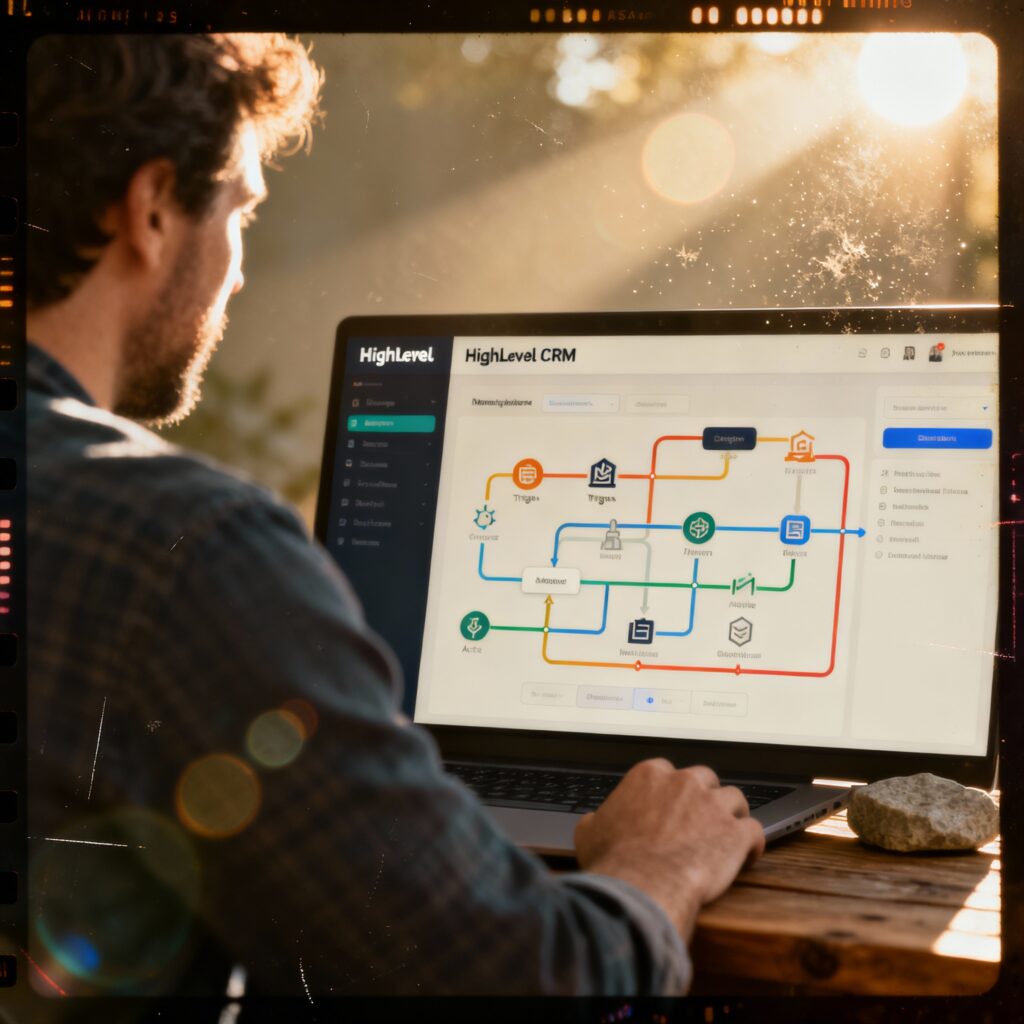
Automation defines how HighLevel CRM supports consistent communication at scale. Businesses can create workflows that respond to customer actions, time delays, or pipeline changes. These workflows handle repetitive tasks such as sending reminders, confirming appointments, or nurturing leads over time.
By automating routine interactions, teams reduce manual workload while maintaining consistency. Automation also improves reliability, since systems execute tasks the same way every time. IBM highlights automation as a foundational element of scalable operations, noting its role in reducing error and improving efficiency. You can explore IBM’s perspective further at IBM. HighLevel CRM applies these principles directly to customer management.
Sales pipeline clarity and forecasting
Sales pipeline visibility plays a major role in how businesses plan and grow. HighLevel CRM allows teams to define pipeline stages that reflect their actual sales process. Each lead moves through these stages based on activity and engagement, giving teams a clear picture of progress.
This structure supports better forecasting and prioritization. Teams can identify where leads stall and adjust messaging or follow up timing accordingly. Clear pipeline organization resembles the importance of structure seen in Technical SEO Services, where performance depends on how well systems are organized beneath the surface rather than surface-level changes.
Centralized communication and continuity
Consistent communication often determines whether a lead converts or disengages. HighLevel CRM includes built in email, text messaging, and call tracking tools that allow teams to manage conversations from one interface. Every interaction attaches directly to the contact record.
This centralized approach improves continuity and accountability. Team members can review past conversations and respond with full context, even when multiple people interact with the same lead. Forbes has discussed how consistent communication strengthens customer trust and brand perception, which you can explore further at Forbes. Systems that support communication continuity reduce friction in customer relationships.
Marketing workflows and lead capture integration
Marketing integration plays a significant role in defining what is HighLevel CRM. The platform includes tools for creating landing pages, forms, and campaigns that connect directly to contact records. When a lead submits information, HighLevel CRM captures it instantly and triggers predefined follow ups.
This integration removes delays caused by manual imports or broken connections between platforms. It also supports smoother customer journeys, where interest flows naturally into engagement. These goals align closely with SEO Services, which focus on attracting qualified traffic and guiding users toward meaningful action through well structured pathways.

Scalability and adaptability over time
Businesses evaluating what is HighLevel CRM often consider whether it can support growth without constant restructuring. As lead volume increases and teams expand, systems must adapt without becoming difficult to manage. HighLevel CRM allows customization of pipelines, automation workflows, and user permissions.
This flexibility supports long term growth without forcing businesses to replace systems as needs evolve. Maintaining and refining systems over time remains essential, which connects closely to Website Maintenance. Ongoing optimization ensures tools continue to support business goals rather than restrict them.
Security, access control, and data responsibility
Security remains a critical consideration for any platform handling customer data. HighLevel CRM applies modern access controls and permission settings that allow businesses to manage who can view or modify sensitive information. These controls help protect customer data while still enabling collaboration.
The World Wide Web Consortium provides guidance on secure web practices at W3C, which influences many modern software security frameworks. Applying these principles helps ensure that customer data remains protected as systems grow and integrate with other platforms.

Conclusion
Understanding what is HighLevel CRM gives businesses clarity on how centralized systems improve communication, automation, and visibility across the entire customer journey. By replacing fragmented tools with one integrated platform, teams gain consistency and operational clarity.
When CRM platforms align with broader digital strategies such as WordPress Website Design and long term optimization, businesses build stronger foundations for growth. Best Website Builder Group approaches HighLevel CRM with this integrated perspective, helping businesses create systems that support sustainable performance rather than short term fixes.